
When Deep Value Becomes Deep Doubt
From Cash Rich to Trust Poor: The Hidden Risk in a Seemingly Perfect Setup

You ever stumble upon a stock so cheap it feels like you’re being dared to buy it?
This one’s got the hallmarks of a deep value dream: a growing business, real free cash flow, and a cash balance that exceeds its entire market cap. Throw in some unlevered operations, a TV station, and even a few overlooked real estate assets… and on paper, it’s a no-brainer.
But here’s the kicker—nobody’s talking about it.
Not a single analyst write-up. No blog coverage. No fund disclosures. Just silence. And that’s where it starts to get strange.
Dig deeper—past the filings, past the earnings—and an entirely different story emerges. One that drips with history. Not the kind found in investor decks, but the kind that shows up when you start googling management with words like “boiler room” and “fraud.”
In this premium report, I walk through why this stock may look like a golden opportunity… until it doesn’t. What appears to be a hidden gem might just be hiding something else entirely.
Is the cash real? Can management be trusted? Or is this a mirage wrapped in financials too good to be true?
Read on. You won’t look at the balance sheet the same way again.
Adaptive Ad Systems, Inc. $AATV is a nano-cap stock that owns a platform that places advertisements on cable television networks. The business essentially involves purchasing and placing advertisements on cable channels, allowing businesses to target specific geographic areas or niche audiences. In addition, the company owns a single low-power television station called KRRI in Reno, Nevada along with a handful of other real estate assets. With 56 million fully diluted shares outstanding and a stock price of $0.21 per share, the company has a market cap of $11.9 million. There is $12.7 million of cash on the balance sheet, offset by $20k of debt, giving AATV an enterprise value of negative $764k.
Investment Thesis:
AATV is a cheap stock with $12.7 million of cash, $20k of debt and a market cap of only $11.9 million. The enterprise value is a negative $764k which means you get the entire business for free, and then some. The capital structure includes 51.2 million common shares outstanding and two classes of preferred stock, preferred A and B. There are 500k Class A preferred stock that have 100 votes per share, no dividend, no liquidation rights and no conversion. These are basically super voting shares that gives management control of the company. There are 1.1 million Class B preferred stock outstanding. These are convertible at a 1-5 ratio into common shares after they have been outstanding for five years. Total potential dilution from the Class B preferred stock is 5.5 million additional shares. The Class B preferred stock is issued to the management team and given the non-dividend rights and the ability to only convert after five years, is similar to a restricted stock unit. Total diluted shares outstanding is 56.7 million.
In 2024 the company generated $7.5 million of revenues $2.0 million of operating income and $2.2 million of cash from operations. Capex was $613 million, resulting in free cash flow of $1.6 million. Revenues were up 46% year over year. In 2023 the company generated $5.1 million of revenue, $99k of operating income and $1.0 million of free cash flow. The company has historically generated free cash flow over the past decade and has built a sizeable cash balance.
Everything looks good on paper. You are buying a cash pile and a profitable business that is growing. In addition, the company owns a single TV station and a few real estate assets. It almost looks too good to be true. A hidden asset that you are getting for free. And no one is talking about the stock. Zero individuals have written about this equity. It is a type of “slap me” am I dreaming moment.
But everything is not as it appears. In fact, if you dig deep enough into the named executive officers, major shareholders and even the accountant, major red flags rip through the bullish thesis.
The three individuals who are listed in the annual report are J. Michael Heil, the CEO, Bryant Cragun, a 22% owner through Willmark Investments and Kevin Orton, the owner of Mainstreet Consulting & Accounting Services, the company’s auditor.
The company is ran by an individual named J. Michael Heil. The J stands for Joseph. His LinkedIn is right here. There isn’t much data on Heil if you search for his name. But if you Google his name along with “boiler room” some interesting data pops up.
The first thread that pops up is from a post in 2011 on the Silicon Investor boards. In the post a user named “jjs64” posts on a thread titled “Boiler Room Operator Bryant Cragun Makes Comeback”. He goes into detail how J. Michael Heil along with Bryant Cragun is involved in a whole bunch of Nevada companies.
If we Google Bryant Cragun along with the keyword “boiler room” and “fraud” there is a bunch of old threads written up about his past business history. The most remarkable is from a post on Investors Hub in 2011 that details one of Bryant’s partners in a boiler room scheme. In the thread it talks about how Bryant ran a boiler room out of Hong Kong and various other countries, pumping fraudulent stocks that eventually went to zero. There is another article written by Share Sleuth titled “Hot Covid-19 test company has tied to offshore boiler rooms”. There is also a Wall Street Journal article titled “Beyond the SEC’s Reach, Firms Sell Obscure Issues to Foreign Investors”. Another article, titled “Chinese coal company’s share placement produces interesting collection of investors” highlights that Bryant was involved in this issue and was the former stockbroker who was the owner of two unlicensed offshore brokerages that sold shares of obscure U.S. listed stocks to investors in Europe, Asia and other parts of the world. Many of the people who bought these stocks lost everything.
The final individual is Kevin Orton, the owner of Mainstreet Consulting & Accounting Services, Inc. which does the auditing for AATV. If you Google “Kevin Orton Fraud” there is a link that leads to this SEC filing from 2001 which found him guilty of securities fraud, wire fraud, money laundering, racketeering, conspiracy and racketeering conspiracy. Here is another article on Kevin Orton which said he got nine years in a federal prison for his part in a major stock fraud. In the article it states that Orton was the certified public accountant for Las Vegas companies Teletek Inc. and United Payphone Services. Here is another thread on Silicon Investor that highlights in detail the operations of Teleket.
What we have now is a cash pile and a seemingly profitable business that appears to be ran by three actors with a shady background. Everything looks ok from the financial standpoint. I don’t see many red flags. Besides the large $1 million cash outflow titled “advances to affiliates” that is located in changes in working capital. My guess is that this is payments to insiders.
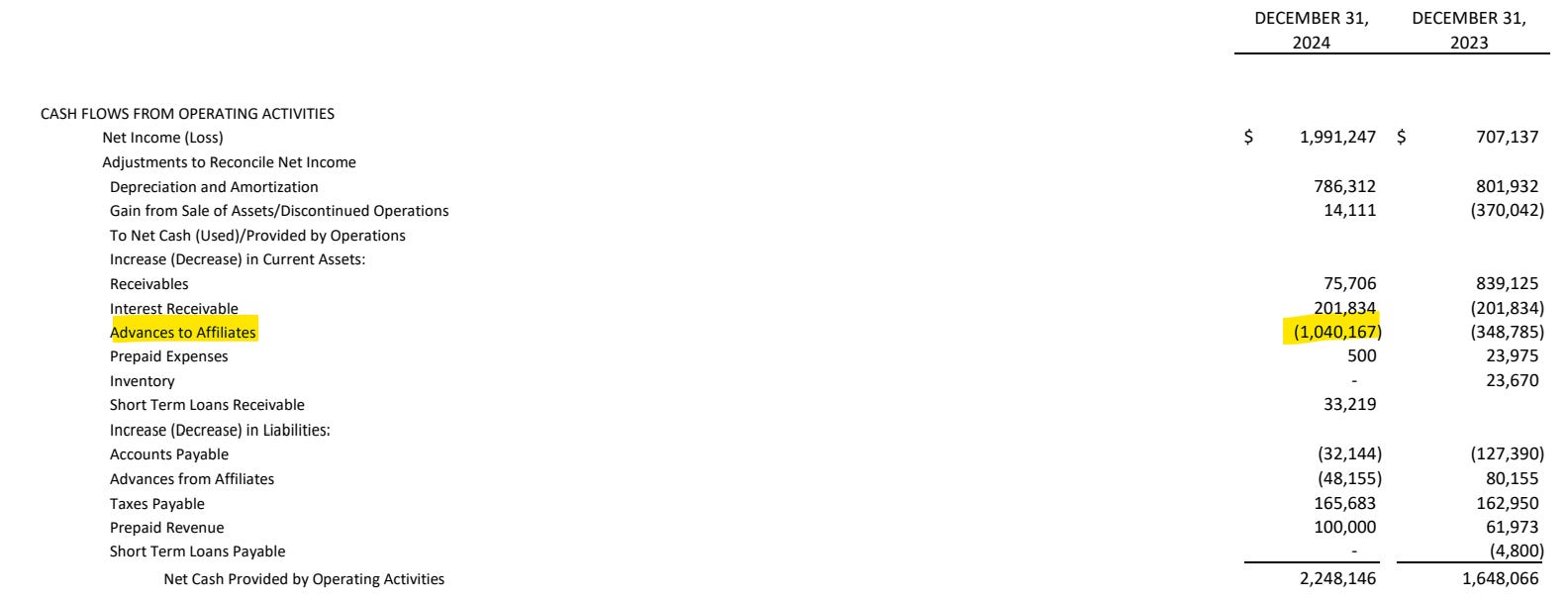
Given the shady history of the individuals above, it begs to question, is the $12.7 million of cash on the balance sheet actually there? The company has a long history of generating free cash flow and building up an impressive balance sheet. But how can investors be sure that cash is actually on the balance sheet given the history of the three named individuals? Any rational management team would likely be using this cash pile to do share repurchases, especially at this valuation, or even doing large special dividends, giving management’s large ownership in the common equity. Given the lack of shareholder returns, can we really trust that the cash is actually there?
On paper, AATV looks like a cheap stock. You get a nice pile of cash and a profitable operating business for free. But if you dig into the CEO, one of the large stockholders and even the individual doing the public accounting, the stock quickly becomes uninvestable. I first looked at AATV and thought it was a screaming buy. However, the lack of writeups on the name was concerning as it is the typical deep value investors dream. The more I dug into the stock the more I kept thinking to myself “what am I missing.” Then after digging into the key players involved in the equity, it became crystal clear, avoid this stock and move on.
Disclosure: I am not long or short Adaptive Ad Systems, Inc. $AATV. This is not investment advice. I am not an investment advisor. Do your own research.
lotsa goofy companies out there. Haven't came across blatant scammers like this however